
Introduction:
In the world of therapy, your counselor may ascribe to one (or several) various theoretical frameworks. Each is a way to help us all understand the complexities of being human! One that has gained significant recognition and attention is the Internal Family Systems (IFS) theory.
Developed by Richard C. Schwartz, Ph.D. (2013), IFS is a transformative approach to counseling that is all about:
- Empowering you to explore your internal world
- Integrating the different parts of your inner world
- Embarking on a journey of self-discovery, healing, and personal growth
Sound good? This article will shed light on how IFS is used, and how it can bolster your work in therapy and beyond.
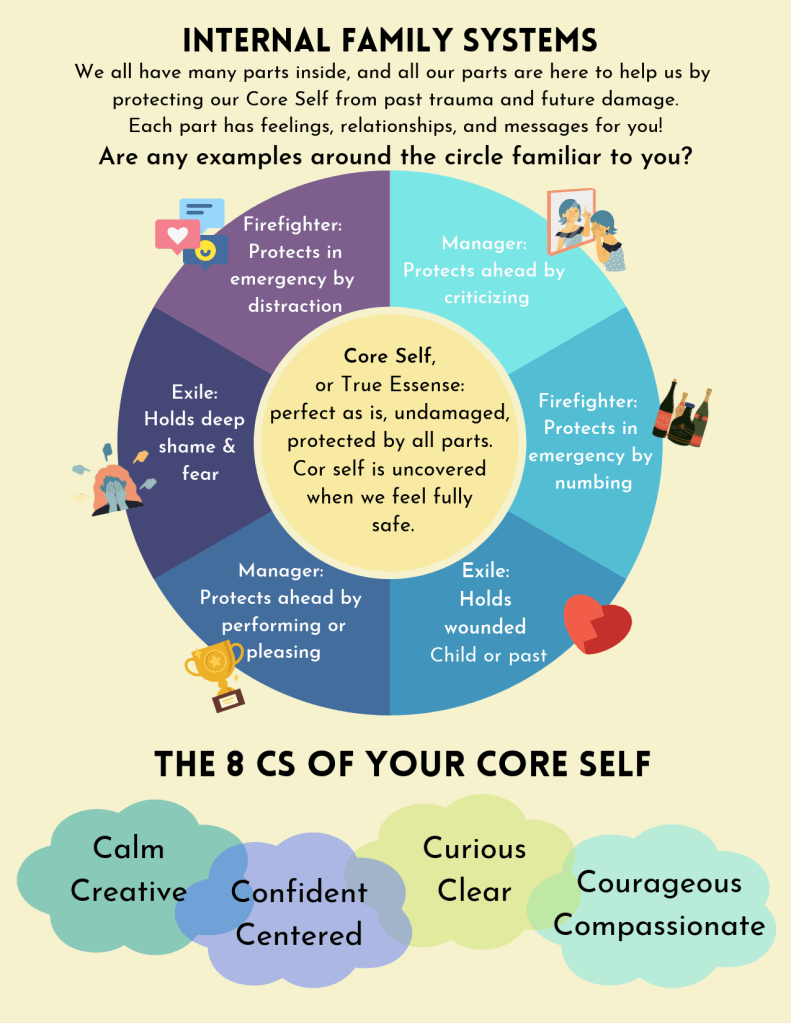
Understanding the Internal Family Systems Theory:
At its core, the Internal Family Systems theory suggests that every individual possesses a multitude of “parts.” Each part has unique emotions, thoughts, beliefs, and jobs to perform for you. These components of a person can be protective, wounded, or managerial in nature, and they manifest sometimes as conflicting desires and reactions to life, such as mood fluctuation, emotional pain, substance use or self-medicating, internal conflict and anxiety, and shutting down. Any of those sound familiar? IFS views the human psyche as a system, similar to a family, where each part plays a role and contributes to the overall functioning of the individual.
How do we tap into these parts?
Working with Parts:
When working in therapy with an IFS perspective, the therapist and client work together to identify, understand, and even heal these different parts, if needed. By externalizing (discussing, visualizing, etc.) and engaging with these parts, clients can gain a deeper understanding of their internal dynamics, which builds greater self-awareness, self-compassion, and self-acceptance. These pave the way for wellness and self-actualization. The process with the therapist allows the client to:
- Explore emotions
- Identify deeply held beliefs, even subconscious ones
- Gently examine behaviors with curiosity, rather than criticism
Unburdening and Healing Your Parts:
The central goal of your IFS work in therapy is to cultivate harmonious relationships between and among your various parts. You will be helped in developing empathetic and compassionate connections with each part. They have needs, and at least one or two of them are likely ready to share them with you.
How? Through guided introspection and dialogue (some internal and some verbal with your therapist), you will learn to access your internal resources and create a safe environment for parts to express themselves fully. By doing this, you’re unburdening these parts, and therefore your whole self, and fostering healing of wounds, restored balance, and integrations within your internal system.
Integration and Self-Leadership:
Attuning to your parts is a skill. It takes patience, practice, and openness. As you become proficient in navigating your internal landscape, IFS focuses on facilitating and integrating your parts. What does that mean? You’ll establish a collaborative relationship between your parts, allowing them to work together toward shared goals (your goals), rather than each operating in isolation or conflict.
With increased internal harmony, you’ll develop a sense of self-leadership, meaning your true self – the core or undamaged essence of YOU – guides and nurtures your various parts.
Benefits:
The Internal Family Systems theory has shown remarkable efficacy, and here are a few key benefits and applications:
- Trauma recovery: IFS offers a gentle, empowering approach to healing from trauma. Most of us have one or more parts whose job has been to hold on to our trauma, so that we can move forward in day-to-day life. IFS allows clients to gradually process and integrate traumatic memories and the parts that carry them (Schwartz, 2013).
- Anxiety and Depression: By understanding and unburdening the underlying parts and their beliefs, symptoms of depression and anxiety can be improved while developing healthier coping mechanisms (Green, 2008).
- Relationships and Interpersonal Issues: IFS helps clients to explore the parts that influence their relationships, fears, and reactions. This enables them to build healthier connections and to navigate conflicts more effectively (Schwarts, 1995).
- Self-Exploration and Personal Growth: IFS is a powerful tool to help clients gain insight into their inner world and develop a more authentic, compassionate, and loving relationship with themselves.
Conclusion:
If you are interested in emarking on a transformative journey of self-understanding, healing, and growth in therapy, IFS is an excellent approach to consider. By embracing the various parts within yourself, cultivating self-compassion, and integrating your immense, innate resources, you can step into a place of self-leadership and create positive change in your life. With the support of your counselor, the Internal Family Systems theory offers a pathway toward inner harmony, resilience, and a more fulfilling life.
If you do not already have a skilled therapist in your life, consider taking steps to begin seeking support on your journey.
Sources and continued reading:
Anderson, F., Sweezy, M., & Schwartz, R. (2017). Internal family systems skills training manual: Trauma-informed treatment for anxiety, depression, PTSD & substance abuse. PES
Green, E. J. (2008). Individuals in conflict: An internal family systems approach. The Family Journal, 16, 125–131.
Herbine-Blank, T. (n.d.). Couples & marriage counseling with internal family systems therapy. IFS Institute. Retrieved November 18, 2021, from
IFS Institute. (n.d.). The internal family systems model outline. Retrieved November 18, 2021, from https://ifs-institute.com/resources/articles/internal-family-systems-model-outline
Schwartz, R. C. (1995). Internal family systems therapy. New York: Guilford Publications.
Schwartz, R. C. (2013). Moving from acceptance toward transformation with internal family systems therapy (IFS). Journal of Clinical Psychology.
Schwartz, R. C. (2021). No bad parts: Healing trauma and restoring wholeness with the internal family systems model. Sounds True.
Sweezy, M., & Ziskind, E. L. (2013). Internal family systems therapy: New dimensions. Routledge.
 Kathleen Burk Counseling, LLC
Leave a comment